From Temple to Table: The Legacy of Madagascar Vanilla Essential Oils Part 1
Updated: Oct 16, 2025
Welcome back to Harvesters’ Corner! Today we are looking at Vanilla, specifically Madagascar Vanilla, which is also known by the name Bourbon Vanilla. I thought I knew a fair amount of information concerning Vanilla, and I must confess that I have tmy urned pleasantly surprised at how much I have learned where this delicious plant is concerned. Come join us as we learn the history, traditional uses, and challenges concerning Vanilla.
The Legend of Vanilla it

I was familiar with the term “Madagascar Vanilla” through using the product in baking that I have done in the past. I was also familiar with the term “Mexican Vanilla” as well. Through my research I came across the terms “Bourbon Vanilla” and “Tahitian Vanilla,” as well. What were these new Vanillas, and how were they used? The answer, I discovered, was found in the plant’s history. Almost all of the spice oils we have looked at on previous posts moved east to west, most typically from India or China towards Europe and then on to America. I had assumed this was the case with Madagascar Vanilla. I was wrong. The historical movement of Vanilla was from west to east! The traditional habitat for the plant was the lowland coastal region along Mexico’s gulf coast, in what is modern-day Veracruz. Back in the early days of the Totonac people lived a ruler, King Teniztli the third. One of his daughters, named Tzacopontziza (Morning Star), had grown to be a beautiful, talented, and intelligent young lady. Many suitors approached the king for permission to court Morning Star, but all were denied for her father felt that no one was worthy of his daughter. To keep Morning Star unsullied by the world, the king sent her to serve as a handmaiden in the temple of Tonacayohua, the Corn Goddess. It was a peaceful life, with daily excursions into the rainforest to gather fruits and flowers as offerings for the goddess.
One day, as Morning Star was out gathering the day’s offerings, she was secretly watched by the keen eye of a warrior, Zkatan-Oxga (Young Deer), who was out hunting. He was smitten by the maiden’s beauty and watched her from concealed locations as she went about her tasks. Young Deer recognized by how she was dressed that she was a temple maiden and knew it was sacrilege to watch her, but the love which he felt towards her outweighed the risks of being captured and killed.
After several days carefully shadowing the maiden, Young Deer approached Morning Star as she stood next to a cheerfully bubbling stream. Once she overcame her shock at the warrior’s sudden appearance she listened as he proclaimed his love for her. A surge of emotion flooded through Morning Star, and she wanted to be with the man before her. This created a problem for the young lady, as her life had been dedicated to the Corn Goddess. Recognizing that their mutual love would create difficulties, the two lovers chose to flee to the mountains.
The couple’s flight was observed from a distance by a temple priest, whose responsibility was to guard the maidens as they were in the forest. When he reported what he witnessed to the priests in the temple, they implored Chichini, the Sun God and consort of the Corn Goddess, for assistance in capturing the fugitives. The Sun God caused a hideous monster capable of spewing fire from its mouth to awaken and leave its cave. It spat out streams of lava-like fire as the lovers approached and blocked their advance. As they retraced their steps down the mountain the couple were captured by the temple warriors dispatched by the priests. That night, as midnight approached, Young Deer and Morning Star were brought before the temple priests. The lovers were beheaded and their hearts removed and placed on a makeshift altar as an offering to the Sun God, and their bodies were cast into a ravine.
The Corn Goddess, who was also known as “The Preserver of Flesh,” was saddened by the loss of her handmaiden. The goddess caused a bush to grow from where Young Deer’s body lay, and a vibrant green climbing vine sprouted from where Morning Star’s body rested. The vine wrapped around the bush in a loving embrace. After several months flowers appeared on the vine, delicate yellow-petaled orchids. Clusters of long seed pods sprouted from the flowers and the air was soon scented with the rich aroma of the pods. The priests recognized the goddess’s intervention in the appearance of the plants, and from that time on the orchid and the seed pods were gathered a as sacred offerings to the Corn Goddess.
Enter the Conquerors
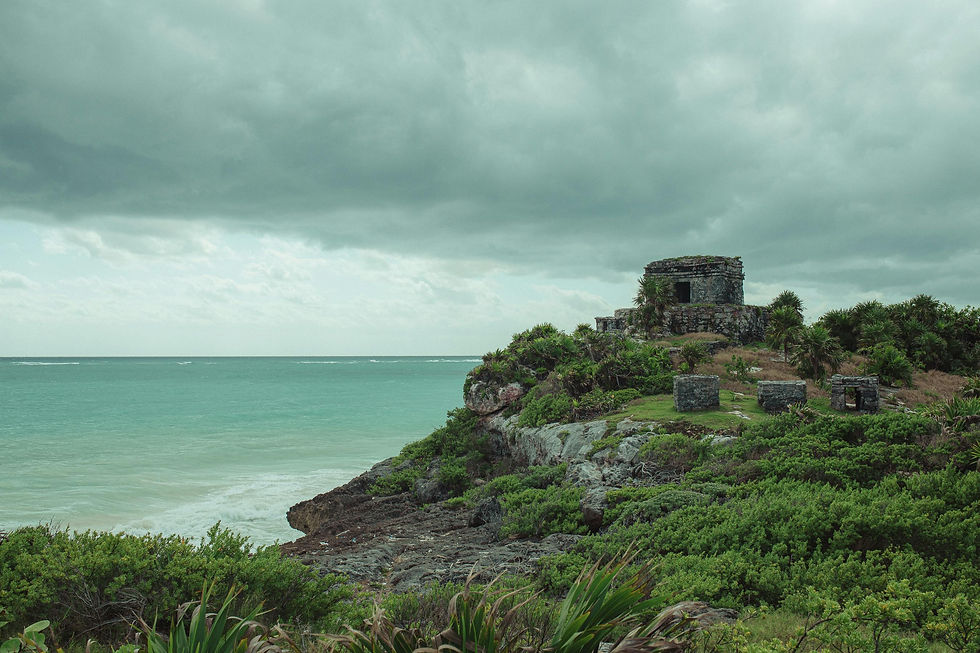
The Totonacs became the premier Vanilla experts in Mezo-America. When the Totonac people were conquered by the Aztecs in the mid-1400s, a portion of the tribute paid to the fierce subjugators was in the form of Vanilla seed pods. Consequently, when Hernán Cortéz arrived in Mexico around 1519 and vanquished the Aztecs, he became familiar with Vanilla and its use in beverages.
To be honest, this was not the first contact with Vanilla where the Spanish Empire was concerned. The seed pods had been exported to Europe since the early 1500s, where they were used in perfumes. (1) Because of Cortez and his experiences, Europe began experimenting with Vanilla in foods and beverages, and the brown wrinkled beans became very popular. For close to three hundred years Europe’s only source of Vanilla was seed pods shipped from Mexico. But then, around 1793, a vine was smuggled out of Mexico and shipped to Ile Bourbon, a French island in the Indian Ocean. (2) The vine thrived in the tropical climate, the flower blossomed just as it did in Mexico, but no seed pods developed! Over time botanists learned that a specific bee in Mexico pollenated the orchid. Without the bee’s work, no seed pods would grow.
A Critical Discovery
Around 1841 a twelve-year old boy, who was born into slavery on a plantation on Ile Bourbon (now modern-day Reunion Island), made a breakthrough discovery. Edmond Albius’ mother died in childbirth, and the French colonist, Féréol B. Beaumont, who enslaved her raised the boy. As young Albius grew, he was trained in botany by Mr. Beaumont, One principle the boy learned was how to fertilize flowers, and he soon discovered that a thin stick could be used to pollinate the Vanilla orchid. Nearly thirty years later the vine was introduced into plantations on the northern tip of Madagascar, and the final element of Vanilla production as we know it was in place. (3)
The fertilization method developed by Edmond Albius is still used today, and is part of the reason why Vanilla is so expensive. “Expensive?” I hear you scoff. “Why, I can buy a bottle at the grocery store for five dollars (US).” I agree that you can do that. You will get a bottle filled with a synthetic form of Vanillin, a component of Vanilla, which is made up of byproducts from wood pulp combined with tar. Pure Vanilla is expensive because of the labor involved and is actually second only to Saffron as the most expensive spice available.

The different varieties are very similar, yet very different. All are descendant from the original variety found in Mexico. “Bourbon” Vanilla has been grown in or transplanted from the Bourbon Islands. This includes Reunion Island and Madagascar. The latter location produces close to eighty percent of the world’s Vanilla. Tahitian Vanilla is grown in the south Pacific. Their differences stem from the soil where the vines are grown. There are many who shy away from Mexican Vanilla, as it often contains the additive coumarin, which was banned as a carcinogenic in the US in the 1950s. (4)
Vanilla, as indicated previously, develops from an orchid, and is the only orchid cultivated for its fruit. The flower blossoms once a year, for one day only. Considering that the flowers must be fertilized to produce the seed pods, this makes for a very busy day for the growers. If the delicate flower gets damaged in the process, no fruit will grow. Once the flower is fertilized, the seed pods are allowed to grow for nine months before they are harvested. The most important time of that development is the last four months, when the pods mature and the oils are produced. (5) The grower must move quickly once the pods are ready for harvest, for they begin to ferment as soon as they are cut from the vine. The farmer hurries along gathering pods and placing them in a bag. The full bags, which weighs about forty pounds (18 kg), are then carried on the grower’s back to a sorting and processing station, often located miles away over thick, muddy roads.
At the processing station the grower gets paid, and the pods are sorted and placed in a loosely woven basket, which is then placed in a pot of boiling water for three to five minutes. This halts the fermentation process. The basket is then quickly carried to an adjacent room, where the steaming beans are dumped into a container with other beans, and then covered with a heavy burlap tarp. The beans are allowed to cook, so to speak, for three days. During this time the beans turn from bright green to a deep, rich brown.
The beans are then carried outdoors and spread out to dry in the sun for a period of fifteen to thirty days. If rain begins during this time, workers rush out with tarps to cover the beans, as excess water will cause the beans to turn moldy. Once the beans have dried, they are gathered, inspected, sorted, and bundled for shipment to distributors. For beans destined to become essential oil, they are then chopped into fine pieces and placed into the distillation unit. The high volatility of many components in Vanilla oil means that the traditional steam distillation process can’t be used. In place of this, the pods go through a super-critical Carbon Dioxide (sCO2) distillation process, and environmentally safe process which results in a very pure oil.
Much skill goes into growing Vanilla. “You can’t just put seed into the ground, tend to it, and expect it to produce a yield. Hand pollination is a learned skill,” states Tim McCollum, co-founder of a direct trade chocolate and vanilla company. “Many farmers have been growing vanilla for three to four generations. Smallscale farmers…have an absolute sixth sense as to when the orchids will bloom.” (6) People growing Vanilla dedicate much of their lives tending to the crop. Like growers everywhere, they are at the mercy of the weather. In 2018 tropical cyclones struck Madagascar and damaged much of the crop, driving pries to nearly US$300 per pound (US$600 per kilo). During the COVID pandemic the price was close to US$160 per pound (US$350 per kilo), and due to price controls instituted by the Madagascar government, are now US$113 per pound (US$250 per kilo) for the processed seed pods. The growers, however, receive about US$8.00 per pound (US$17 per kilo) for their efforts. (7) If the price is driven up by demand or disaster, theft becomes rampant. Some farmers combat this by harvesting the pods early. However, this decreases the payout they receive and also decreases the quality of the end product,

Due to agreements in place with Co-Impact Sourcing, the growers in the SAVA region of Madagascar know what they will receive for their crops before they harvest. (8) The local co-operative enables the growers to help watch over each other’s crops, reducing the risk of theft. This advantage is only one of several which the growers working with dōTERRA enjoy.
There is still much more to cover where Vanilla is concerned, including some exciting new research into potential future uses for Vanilla essential oil. I encourage you to join us next time as we dive deeper into this precious gift of the earth and learn more about how it helps us. Until then, stay safe and keep sharing the oils!
SOURCES
1. Rain, Patricia. “History of Vanilla.” Online. <https://vanillaqueen.com/facts-about-vanilla> Accessed 17 June 2025.
2. Nielsen-Massey. “History of Vanilla.” Online. <https://nielsenmassey.com/history-of-vanilla/#:~:text=Early%20History%20%E2%80%93%20The%20Totonac%20People,and%20their%20control%20over%20vanilla.> Accessed 17 June 2025.
3. Rodelle Kitchen. “Vanilla History.” Online. <https://rodellekitchen.com/resources/ learning/vanilla-history/> Accessed 16 June 2025.
4. Cooks Vanilla. “The Mysteries of Mexican Vanilla: Ancient Legend and Modern Intrigue.” 14 November 2023. Online. <https://cooksvanilla.com/blogs/news/the-mysteries-of-mexican-vanilla>. Accessed 21 June 2025.
5. Sethi, Simran. “The Bittersweet Story of Vanilla.” Smithsonian Magazine, 3 April 2017. Online. <https://www.smithsonianmag.com/science-nature/bittersweet-story-vanilla-180962757.> Accessed 16 June 2025.
6. Sethi, Simran. “The Bittersweet Story of Vanilla.”
7. Business Insider. “Vanilla is the 2nd Most expensive Spice. So Why Do Madagascar’s Farmers Live In Poverty?” 11 December 2022. Video, You Tube. Accessed 16 June 2025.
8. “SAVA” is an acronym formed by the initals of the main production town in the region: Sambava, Antalaha, Vohemar, and Andapa. See “The History of Madagascar Vanilla.” Sambavanilla, 13 January 2023. Online. <https://sambavanilla.com/en/ blog/the-whole-history-of-madagascar-vanilla-n91?srsltid=AfmBOop8AzTtFSUuocJ2MuNpZ6hQVSEjBpzp_bYXDo0Y5btR86RjwSLY>. Accessed 16 June 2025.
Disclaimer
All views on Harvesters’ Corner are those of the author. I am a Wellness Advocate with dōTERRA, and I use the essential oils daily. Any purchases made through my affiliate link may earn me a commission. The oils are not intended to treat or cure any illness.


Comments