Naio Wood Essential Oil: A Rising Star From Hawaii
- delilahproctor
- Nov 16, 2024
- 6 min read
Updated: Oct 5, 2025
Welcome back to Harvesters’ Corner! A couple of months ago I was riding in my husband’s car when “Bruddah Iz” came on singing about the white sandy beaches of Hawaii. (1) The soothing notes of the ukulele and his rich tenor voice painted a wonderful picture in my mind. As I thought about Hawaii, my mind drifted to thoughts of Kealakekua Mountain Reserve (KMR), where dōTERRA is working with the state of Hawaii to grow ‘iliahi, or Hawaiian Sandalwood. Imagine my surprise when I went to the annual convention a few weeks later, and was able to meet Greg Hendrickson, manager of KMR, and learn about how the reserve is doing, as well as learning about a new product coming from the reserve.

KMR is thriving. Over 500,000 trees have been planted in the reserve, well on the way of reaching the goal of one million trees by 2030. (2) Individuals from multiple communities around KMR are spending time volunteering in the nursery watching over seedlings and transplanting the tender shoots into larger containers in preparation to the tree’s planting. The impact that the trees are having on the landscape is impressive. Remember that the ‘iliahi is a parasitic tree and requires a host for support in the early years. Since the opening of KMR in 2018, the landscape has changed from scrub brush and scattered ground cover to a lush tropical jungle. Fogs which used to roll in off the ocean and drift over the landscape now are lingering and releasing moisture over the land. Young saplings, barely twelve inches tall, now tower more than ten feet tall. It is a marvelous change to see happening.
History and interesting facts
In our prior ‘iliahi post, we talked about how overexploitation of the ‘iliahi trees threatened their existence. As they grew scarce, unscrupulous shippers tried to substitute another tree as a means of filling a ship’s hold. This other tree was Naio (Myoporum sandwicencse), which is also native to Hawaii. The wood of the Naio tree was easy to carve, and the scent resembled ‘iliahi ’s scent, even though Naio’s didn’t last as long. However, the Oriental importers refused any shipments with Naio, leading to the tree being branded as “False Sandalwood.” Ironically, this unflattering label spared the tree from overharvesting.
Naio can take a variety of forms as it is cultivated. At lower altitudes it tends to spread out as a ground cover, while it grows taller at higher elevations. Naio wood has been used by native Hawaiians for its durability. Spears, utensils, net gauges, housing frames (hale, pronounced ‘hah-leah’), even the ornamental prows (manu) on their canoes were made from Naio wood. (3) It has also been used extensively in incense. As forests have been cleared for homes, the land available to Naio has dwindled, resulting in it being classified as a threatened species. Because of this, Naio is also being cultivated at KMR to help restore the overall population to a healthier level. Not all of the saplings raised will go to the reserve. As was seen back in December 2023, KMR played an extensive role in the planting of trees on Maui after the Lāhainā Fire.
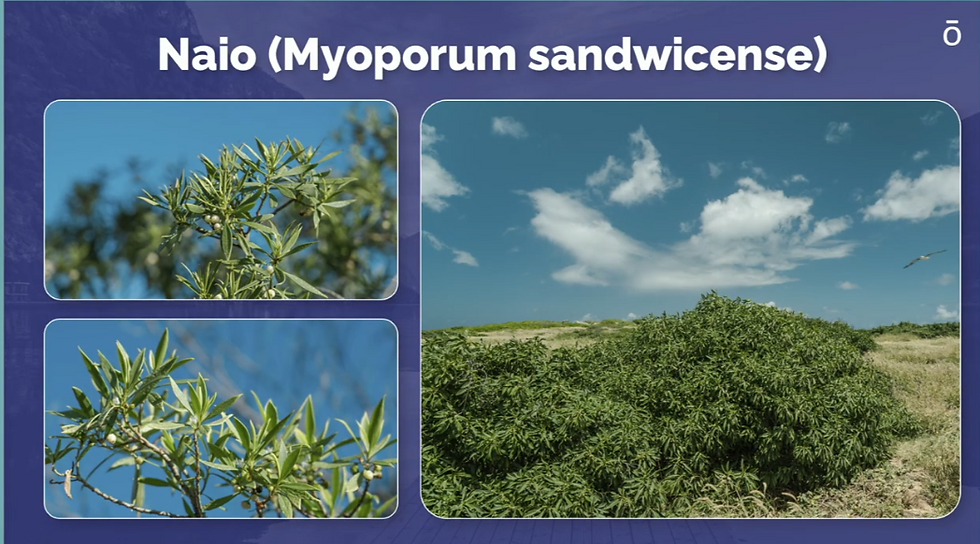
Naio is much more than just a beautiful tree and groundcover. Like ‘iliahi, Naio can be distilled into an essential oil for our use. But being able to distill an essential oil and understanding how to use that oil are two separate disciplines. Enter the Aeromatic Plant Research Center (ARPC), an independent laboratory striving to increase our understanding where essential oils and the body are concerned. The ARPC was founded by Aaron Sorensen and Dr. Prabodh Satyal for the purpose of utilizing state-of-the-art research to provide clients with access to the most sophisticated and verifiable means of testing available. Samples of Naio oil were sent from Hawaii to the ARPC, and the tests revealed exciting results. They showed that Naio has a high alpha-Bisabolol content. (4)
Now we talk Science
“What,” I am sure you are asking, “exactly is alpha-Bisabolol?” Bear with me here, as we are going to talk a bit about science. Alpha-Bisabolol is a terpene, or in other words, a compound that is a naturally occurring molecule. Terpenes are widespread in nature and are found in a variety forms in multiple essential oils. Terpenes are classified based upon their chemical organization and the number of carbon atoms (C) they have. For example, there are monoterpenes with ten carbon atoms (C10), sesquiterpenes (C15), diterpenes (C20), and triterpenes (C30). Alpha-Bisabolol is a sesquiterpene. These different kinds of terpenes have specific characteristics which influence fragrance, taste, and even color in plants. They also help support the plant’s immune system.

Believe it or not, you have already had contact with alpha-Bisabolol. Black Pepper (Piper nigrum) and German Chamomile (Matricaria chamomilla) both possess alpha-Bisabolol. Its scent is slightly spicy and woody, with hints of floral overtones. If you have taken a deep breath over a steaming cup of chamomile tea or smelled freshly ground pepper, then you have inhaled alpha-Bisabolol.
Why is alpha-Bisabolol important? Its biological functions include being antioxidant, anti-inflammatory, neural protective, and analgesic. If these terms are unfamiliar, don’t worry. The key take away is that alpha-Bisabolol is very good for you and your body. This is where Naio wood becomes important, as its levels of this sesquiterpene are very high, among the highest found in nature, and it also helps enhance the properties of other essential oils. [Note: These statements have not been evaluated by the FDA. This product is not intended to diagnose, treat, cure, or prevent any disease.]
How do I get some?

Presently, Naio is available in one of dōTERRA’s new products, the Frankincense Stick + Naio Wood. This topical rub-on stick helps restore and promote healthy and revived skin, one of our prime defenses against the world around us. Dr. Brannick Riggs, VP of Essential Oil Education at dōTERRA has said, “The skin is your body’s largest organ. It’s highly adaptive and plays many roles. It’s your first layer of protection, regulating temperature, preventing dehydration, and helping with vitamin D production. Isn’t it of vital important then to keep your skin healthy?” (5) He then added, “I’ve been using [the Frankincense Stick with Naio Wood] every day on my hands. On those Saturdays when I’ve been working in the yard for hours, I use it to soothe the minor irritations that pop up after a day of hard labor…After reading the research on Frankincense oil and the alpha-Bisabolol content in Naio Wood and then experiencing the product for myself, I’m convinced it’s one of the best ways to support healthy skin.” There are many gifts of the Earth in our wide, wonderful world. Thanks to the ARPC and the purity commitment of dōTERRA, we are finally understanding how these wonderous plants can benefit us in maintaining a healthy lifestyle. I encourage you to experience the restorative properties of Frankincense and Naio for yourself.
As you can see, with the science behind the oils, there is an entirely new world to understand where essential oils are concerned. My hope is to help people better understand the science, so they can better appreciate and use the oils in their lives. As stated in my post-convention blog, I will soon start a series of articles to help us better understand the science and testing being done on the oils and why this testing is so important for increasing our understanding of the oils.
Join us next time, here at Harvesters’ Corner, when we return to the Mediterranean region to take a look at Rosemary. Until then, stay safe and keep sharing the oils!
Sources
1. Bruddah Iz—Israel Kamakawiwo’ole (1959 – 1997)—was a Hawaiian singer whose size was surpassed only by his talent and heart. Bruddah Iz had many hits through his career, including “E Ala E,” “White Sandy Beaches,” a Hawaiian take on “Take Me Home Country Road,” “Over the Rainbow/Wonderful World,” and the ever haunting “Hawai’I ‘78.” His was a voice of unification and heritage in a time of diversity and loss.
2. PR Newswire. “Over 500,000 Trees Planted at Kealakekua Mountain Reserve on Hawaii’s Big Island.” 8 August 2024. Online. <https://www.prnewswire.com/news-releases/over-500-000-trees-planted-at-kealakekua-mountain-reserve-on-hawaiis-big-island-302217691.html>. Accessed 9 October 2024.
3. Krauss, Beatrice H. Plants in Hawaiian Culture. Honolulu, University of Hawai’i Press. 1993.
4. Aromatic Plant Research Center. “ Naio.” 7 February 2024. Online.< https:// www.aromaticplant.org/post/_naio>. Accessed 7 October 2024.
5. dōTERRA. “Frankincense Stick + Naio Wood.” Online. <https://www.doterra.com/US/en/p/frankincense-stick-naio-wood >. Accessed 16 October 2024.
Disclaimer
All views on Harvesters’ Corner are those of the author. I am a Wellness Advocate with dōTERRA, and I use the essential oils daily. Any purchases made through my affiliate link may earn me a commission. The oils are not intended to treat or cure any illness.


Comments